
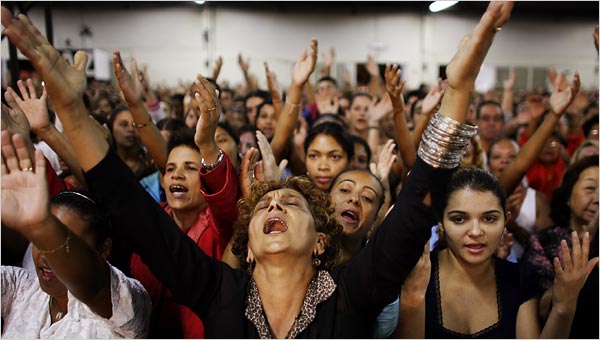
A new framework is needed to confront the excessive focus on miracles and healing within Charismatic practice and liturgy. When taken to extremes, these practices can delay medical care and alienate the broader public.
Table of Contents
- Introduction
- Who are Charismatics?
- Problems with Exhibitions of Divine Healings
- The Historic Problem of Supernaturalism
- Origen and Chrysostom on Miracles
- Aquinas on Miracles
- David Hume on Miracles
- William Lecky on Miracles in Europe
- Pope Benedict XIV
- Building a Proper Framework
- A Charismatic Response
- Final Thoughts
Introduction
If you attend almost any Charismatic church meeting, you are sure to hear about supernatural healings. They are usually abstract ones, such as headaches banished, a sore back relieved, a short leg lengthened, and many other unusual conditions cured. The majority are scientifically unproven because they are too vague.
The outside observer finds these claims silly and a source for public ridicule.
Certain contemporary Christian movements, especially the Charismatic-led ones, practice this regularly as special advertised meetings, but not always on Sundays. Some of these exhibitions and leaders within the movement have brought Christianity as a whole under suspicion. The practice has become a central source of rejection and disrespect in North American society.
Mysticism, along with its healing progeny, has paralleled the Christian experience from inception.
The need to understand and regulate supernatural healing parallels this rich history. This article examines a few theologians and philosophers from the second century onward to build a proper framework for 21st-century Christian living.
Many of the solutions that were applied back then have usefulness for today’s experience.
The question is not whether God can act miraculously in any circumstance, but how fallen human nature can distort or exploit the understanding and application of such claims.
Who are Charismatics?
Many readers are probably asking, who is a Charismatic, and why should I care? The following answers these questions.
Charismatics are people mainly from the 1960s onward, inspired by the Pentecostal wave that began in the early 1900s. Their central doctrines emphasize a mystic union with God through the baptism of the Holy Spirit, speaking in tongues, and sensitivity to the supernatural.
The Charismatics initially continued attending their Anglican/Episcopalian, Baptist, Methodist, and other mainline churches. They tried to bring their spiritual awakening to their traditional brethren but failed. The result was that many of these people voluntarily left or were forced out. As a consequence, these people formed their independent churches.
These collections of independent churches are the substance of the Charismatic Movement. Apart from their emphasis on the supernatural, a significant attribute is the autonomous nature and avoidance of denominational or sectarian features. Because of this, there is a wide range of expressions and practices within the Charismatic Movement. There is no key leader, Church, or theologian that represents them. Dialogue and cooperation exist among these independent churches, but there is no desire to form a hierarchical structure.
Those churches that remain in their denominations but under the influence of the Charismatic Movement are called Third Wave churches. These often emphasize healing services.
One may think that the Charismatic Movement is a small slice of the religious pie, but this is not the case. It is one of the fastest-growing segments of the Christian faith worldwide. In the United States alone, the Barna Group states that 4 out of every 10 independent churches are Charismatic, and 46% of those who attend a Protestant meeting are Charismatic. 1
The practice of divine healings is typical of a charismatic liturgical experience and an integral part of their religious identity.
Problems with Exhibitions of Divine Healings
However, there are severe problems with the mystic rite that the Charismatic Movement must address.
First of all, the public exhibition of divine healings strengthens the public sentiment that those practicing are radicalized religious fanatics. It scares the general populace more than it attracts. This healing practice, which is perceived as a staged act rather than fact by the outside observer, also further alienates the Christian faith from regular participation in public social dialogue.
Secondly, the staged process of divine healing undermines the credibility of the message. A vocal percentage of the general public is hostile and openly antagonistic to Christianity because of the contemporary healing practices by church leaders and evangelists. Critics usually derisively quote faith healers they have seen on television, the radio, or print magazines to back up their assumption that Christianity, and religion in general, is irrelevant for modern society.
This criticism leads to an urgent concern. Unless the various branches of the Protestant churches seriously confront perceived fraud and a lack of accountability in the practice of divine healing, a serious public relations problem will persist. The lack of discipline may lead to a tipping point; some abuse relating to divine intervention may spark the already existent anti-church sentiment and set a precedent for government intervention. As a result, this will send a terrible message that the Church, which is supposed to pursue and encourage moral excellence, is an institution that cannot govern itself or be considered reputable. Whose fault is that? Is it a war on the Church or is it a backlash the Church has created for itself?
The Historic Problem of Supernaturalism
This is not the first time in history that an overemphasis on the supernatural within the Christian community has caused problems.
Origen and Chrysostom on Miracles
Both Origen in the second century and John Chrysostom in the fourth century touched on it. They agreed that very few pious people would ever achieve the ability to perform miracles.2 Chrysostom especially did not want to attach miracles to the Christian identity. He felt that superstition and magic would be an obstacle to personal growth. He also stated that there was a certain danger of pride among miracle workers. He de-emphasized such a ministry because of this.3
Chrysostom shifted the realm of miracles and healings from the individual to the corporate Church and its symbols as a solution. This alternative has its strengths, but, overall, it does not adequately address the issue.
Aquinas on Miracles
Thomas Aquinas especially comes to mind. He lived in a world rife with mysticism and had no problem with it. However, he felt the urgency to add structure to this practice. His combination of both the intellect and heightened awareness of the spiritual realm sets him apart. The title Patron Saint of Charismatics and Pentecostals seems appropriate in this circumstance. However, Sainthood is only granted by the Catholic Church, not by any independent Charismatic or Pentecostal institution. Nevertheless, if these two mystical groups did have this authority and the structure to do so, they probably would. Charismatic leaders have yet to build a framework as robust as Aquinas’s. The present Christian mysticism is still in its infancy. Every leader within this movement should have him for reference.
He realized a fundamental problem and wrote out basic principles for defining a miracle. Although his work is almost 800 years old, it still has value for today.
Thomas Aquinas dwelt deeply on the topic of miracles and formulated the definition into various degrees in the thirteenth century. He cautions against improperly assigning a natural phenomenon as a miracle. One example he used was an eclipse. To the astronomer, it is part of a regular pattern, but to the thirteenth-century layman, it was out of the natural order and, therefore, a miracle.
He describes miracles as something out of the natural order of nature, such as the sea temporarily parting so that people can walk through it. The more the event goes against the laws of nature, the greater the miracle. The healing of a blind person, paralysis, etc., are actions that nature cannot perform and are categorically miracles. Another kind of miracle is when God intervenes, even though nature could have done the same thing, such as curing a fever or bringing on rain. He deems these as a lesser miracle.4
Back then, even in a heightened mystical environment where supernatural realities were considered a natural part of human existence, Aquinas saw excess. “I answer that, Some miracles are not true but imaginary deeds.”5
Aquinas believed that miracles had a threefold purpose:
- Signs:6 a miracle that validates the truth of a mission, person, or enterprise
- Wonders and foreshadowing.7 Miracles such as the resurrection demonstrate a future reality. The shock and awe of such a miracle reframes our outlook on life.
- Great Powers8 that demonstrate beyond a doubt God and His authority over nature and humanity.9
David Hume on Miracles
The eighteenth-century English philosopher David Hume, among others, noted that superstition and adherence to mysticism were too strong a social constant in his society. It permeated all the theatres of decision-making. From this perspective, he produced this powerful sweeping statement.
The many instances of forged miracles, and prophecies, and supernatural events, which, in all ages, have either been detected by contrary evidence, or which detect themselves by their absurdity, prove sufficiently the strong propensity of mankind to the extraordinary and the marvelous, and ought reasonably to beget a suspicion against all relations of this kind. This is our natural way of thinking, even with regard to the most common and most credible events.10
He further added that miracles should not justify a system of faith.11 This statement has a critical application today. The Charismatic Movement views miracles as expressions of its divine authority in the world. They see themselves as a God-ordained movement superior to any other institution. This attitude would anger Hume. Miracles are not to legitimize a movement.
Hume disagreed with the connection between institutional or personal authority established by miracles. Any religious leader who uses miracles to promote their brand may gain short-term popularity by preaching to their loyal audience. Still, in the long term, it creates greater public animosity.
William Lecky on Miracles in Europe
Nor are most Charismatics aware that they are merely reinventing the wheel. The topics of divine healing, mysticism, and the supernatural were central to European society for centuries. It dominated the political and social landscape. William Lecky, in his book, History of the rise and influence of the spirit of rationalism in Europe, described the circumstances in the 17th to 18th centuries as this:
Nothing could be more common than for a holy man to be lifted up from the floor in the midst of his devotions, or to be visited by the Virgin or by an angel. There was scarcely a town that could not show some relic that had cured the sick, or some image that had opened and shut its eyes, or bowed its head to an earnest worshipper.12
He saw no difference in the attitudes of either the Protestants or the Catholics on the subject.
Pope Benedict the XIV on miracles
Previously known as Prospero Lorenzo Lambertini, (1675–1758) this Catholic leader was first an archbishop of Bologna and then added the title of Pope afterwards. He is considered one of the most scholarly and intellectually astute Popes in the history of the Church. He worked for twenty years on the canonical tribunal which evaluated persons nominated for sainthood and miracles. Through this experience he wrote De servorum Dei beatificatione et beatorum canonizatione, On the Beatification of the Servants of God and the Canonization of the Blessed. He established a comprehensive framework for defining a medical miracle. The Catholic Church has established his seven step criteria since then for validating or rejecting any claim for a medical miracle.13
Patricia Treece, author of, “Nothing Short of a Miracle: God’s Healing Power in Modern Saints” explains these seven criteria:
[1] The disease must be serious and impossible (or at least very difficult) to cure by human means; [2] The disease must not be in a stage at which it is liable to disappear shortly by itself; [3] Either no medical treatment must have been given or it must be certain that the treatment given has no reference to the cure; [4] The cure must be instantaneous; [5] The cure must be complete; [6] The cure must be permanent; [7] The cure must not be preceded by any crisis of a sort which would make it possible the cure was wholly or partially natural. 14
It has evolved and is fairly restrictive, involving medical specialists in the final analysis.
Building a Proper Framework
The improper application of miracles and the supernatural was one of the factors that forced a social revolution that rebelled against any perceived spiritual intervention. The de-supernaturalizing also had another critical factor. It deprived the Church of its authority and transferred it to a new entity. Consequently, it enabled society to establish a new set of laws, selection processes for civic leaders, systems of government, and a different framework for scientific exploration. This correction was an overreaction that downgraded the realm of miracles and supernatural into the place of myth; a piece of history that should remind present-day Charismatics to tread carefully.
There is also a theological and common-sense problem. If a church holds regular weekly healing meetings based on the premise that miracles will occur, then they are proposing that they have the power to suspend the laws of nature for an hour or two each week. Such a proposition displays a predictable pattern of health recovery and, therefore, a standard procedure. Such a custom is not consistent with what constitutes a miracle. A miracle is something that cannot be controlled or predicted. This staged event is not a realistic premise for encouraging or practicing.
Miracles do happen, but the definition should be purposely narrow and only declared when something occurs that is obviously outside the laws of regular nature. The cure for a common cold or for back pain is too subjective. An amputated arm that grew back, or somebody clinically defined as dead and then suddenly brought back to life while someone was praying over the coffin, are miracles of substance. However, I have never seen anything like this happen.
A great miracle that shocks and amazes and goes beyond the regular laws of nature should be a rare occurrence, and is a one-in-a-million chance. A person is lucky to witness one in their lifetime. If it happens more regularly, then it is no longer a miracle. It is normative.
Churches that emphasize faith healing must have a clear policy in place. An independent third party must empirically prove any miracle. Therefore, meetings that encourage divine healings should promote that only a health care professional declares whether a miracle has happened.
It is difficult to describe something as a spontaneous healing with many ailments. Diabetes, most cancers, multiple sclerosis, and any other afflictions are all conditions that are difficult to assess. Some can heal naturally or even go into remission. They can hide for long periods and then surprisingly reappear.
These conditions can lead to potential problems if either the faith healer states the person is healed or the person interprets the prayer as a healing one. The circumstance creates false hope and potentially premature death. A sick person who believes that a divine intervention has occurred may fail to take prescribed therapies or refuse medical treatment.
The short of it is this: any alleged great miracle must be visibly or scientifically outside the bounds of natural law. If not, then claim it as something remarkable.
Lesser miracles, such as a healed sore throat, the removal of a fever, or a headache, one should approach with caution. It is hard to distinguish between the natural order of the body’s healing properties and divine interaction. It is best to state it is a remarkable change that one is thankful.
Small, unconfirmed miracles, can also bring existential angst and shame to those who have unanswered bigger prayers. For example, if a person rises up and thanks God for healing their headache, another person may feel God is ignoring their healing from cancer. The one suffering from cancer may feel that they are not good enough to be singled out. This circumstance can potentially reinforce shame, fear, or feelings of abandonment.
A Charismatic Response
Some would counter that the positive affirmation of community prayer heals a broken spirit and can alleviate emotional suffering. This state can then cross over into the physical realm and help those with healing.
Many divine healing services succeed in encouraging people by instilling a sense of hope. Hope is hard to grasp for those who continually struggle due to a physical malady, lack financial means for the most elementary of provisions such as medications, dental work, food, employment, or hurting through a divorce, death, or many other reasons. These are situations where many have quietly given up on life and live in the shadows. Many testimonies from healing services attest to overcoming such obstacles and finding the experience a new kick-start in life.
The psychological help and inspiration of a divine hope appear to be an excellent argument for divine healing services. However, these are not miracles. They are words of encouragement.
Final Thoughts
These last two arguments gloss over the severe trust broken by faith healers and ignore the ominous task of rebuilding it.
A structural framework is required to re-establish trust, and Aquinas, along with Pope Benedict XiV, is a good beginning. If the current stage events continue without any revision, the marginalization and mockery by the greater society will increase against Charismatics. A grievous place to exist. It especially negates all the other positive social contributions made by Charismatics to society in other areas.
- https://www.barna.org/barna-update/congregations/52-is-american-christianity-turning-Charismatic#.Vc1JVB_iubk
- Origen, Against Celsus. As found in The Writings of Origen. Translated by the Rev. Frederick Crombie. Vol. II. Origen Contra Celsum. Edinburgh: T & T Clark. 1872. Pg. 426. For Chrysostom, see the footnote below
- Homily on Matthew 9:32 See also: Chrysostom on the Doctrine of Tongues which covers Chrysostom’s beliefs regarding miracles.
- Thomas Aquinas. Contra Gentiles III 101 “On Miracles.” https://aquinas.cc/la/en/~SCG3.C101.4
- Summa Theologiae: Question 178
- signa
- prodigia sive portenta
- virtutes
- See “The Grace of Miracles “ in Summa Theologica Question 178 https://aquinas.cc/la/en/~ST.II-II.Q178.A1.Obj2
- David Hume. An Enquiry Concerning Human Understanding. Reprinted from the posthumous edition of 1777 with introduction, comparative tables of contents, and analytical index by L.A. Selby-Bigge. http://www.gutenberg.org/files/9662/9662-h/9662-h.htm
- IBID Hume. An Enquiry Concerning Human Understanding.
- William Lecky. History of the rise and influence of the spirit of rationalism in Europe, Volume 1. New York: D. Appleton and Company. 1888. Pg. 157
- https://archive.nytimes.com/schott.blogs.nytimes.com/2008/12/05/lambertini-criteria/ | See also https://www.cambridge.org/core/journals/church-history/article/revising-the-supernatural-prospero-lambertinis-reconsideration-of-the-concept-of-miracle/98636CB98646D3AB16F83BDE2316B7F8 \ for Pope Benedict XIV’s actual work in Latin see De Servorum, Book IV, starting at Chapter 12
- Patricia Treece, “Nothing Short of a Miracle: God’s Healing Power in Modern Saints ,” Sophia Institute Press. 2013

About Charles A. Sullivan
Charles Sullivan is fascinated by the spread of ideas, from ancient texts to modern issues. He particularly examines how faith, spirituality, mysticism, politics, and technology have evolved and influence us today.
As one who has been privileged to actually see a “miracle” happen I feel compelled to make a few comments. Space and time will not permit me to go into the details of my actually witnessing a miracle. It matters not to me whether anyone ever believes me or not; I simply have to give my testimony to having seen a real divine miracle. I have also have seen many miraculous healings that have been medically verified including one with my wife where we have test results showing that she had mitral valve prolapse and one later showing she does not have mitral valve prolapse. This condition can only be corrected by surgery or by God. She never had surgery. So I am personally confident that God does indeed perform miracles and miraculous healings.
This being said, I do agree that unfortunately there are charlatans in the ranks of the church and also many who so want to see the miraculous that they stretch truth and credibility to the breaking point and in doing so serve neither the Christian witness nor God’s purposes. Therefore many in the church would rather take a position avoiding the subject or relegating it to theological suppositions that support the idea that God can do miracles but we really don’t expect to see any. Toward the end of the second century we see the church fathers take on this attitude because while church history and scripture gave witness to miracles the experience of the church did not witness miracles. Throughout history there have been isolated times and places where the miraculous occurred but these reports were few and far between and it was all too easy for them to be dismissed as the over enthusiasm of exuberant believers from the ranks of the common people but those of the intellectual class knew that these were simply folk superstitions. As a modern example I was once in a presentation by the head of the Theology department of Princeton. He was explaining to the group how all the miracles in the Bible were simply psychosomatic and resulted merely from the power of suggestion and belief. After the lecture I shared my miracle story with this person who looked at me and said, “well that couldn’t have been psychosomatic.” To which I respond, ” no and neither were the ones in the Bible.”
My background is in Biblical studies with studies at the Hebrew University in Jerusalem. I concentrate on early Christianity and the Hebraic background to Christianity. I have worked in academic settings for years and have seen the majority of academics to be on the side of those like the professor from Princeton. Their experience is in an academic setting in the world of ideas and theories. Most are agnostic and a few atheist. They don’t believe in miracles and have never seen one nor do they ever expect to see one as they don’t believe they exist. On the flip side, I also have worked as a pastor and I have experienced many people who think that they should leave their brain at the door when they enter a church. Faith all too often means what one believes and when one wants to believe something strongly enough they sometimes create their own reality devoid of our commonly shared reality. This furthers those who wish to distance themselves from the charismatic and divine healing elements is the church.
To all this I say. There is a real God who really exists and who really does miracles. He does not do miracles to entertain or merely to show He can. He doesn’t need to prove Himself to anyone. That will become self evident in time. He sometimes does miracles to proclaim His authority or to give witness to His servants. Jesus instructed His disciples to go and heal the sick. Elijah was given the keys of rain and told Ahab that it would not rain until he said so. But these instances are when God has made someone His agent and empowered him to be His witness and to speak on His behalf. This is not something you can manipulate at your own choosing or for your own glory. We do not see these things as often as we wish because we don’t give ourselves wholly to God to used by Him as He wishes.
However, the church at large is commanded to pray for the sick and to help the poor. We are taught to pray that God’s will be on earth as in heaven. There is no sickness nor poverty in heaven so we have all authority to pray for this to occur on earth. I object to the idea that the modern charismatic churches “stage” miracles. And that they use healings and miracles to draw people into their meetings as if this were something wrong or heretical. The statement was made in the article that, “Any religious leadership that uses miracles to promote their brand may have short term gain by preaching to the choir, but in the long term, the public will be further disassociated.” This statement is in conflict with the saying of Jesus,
“John 10:37 If I do not do the works of My Father, do not believe Me;
John 10:38 but if I do, though you do not believe Me, believe the works, that you may know and believe that the Father is in Me, and I in Him.”
Jesus did miraculous works to promote His mission and to give witness that He was sent by God. To say that His followers can not do the same is contrary to Jesus own words.
“John 14:11 Believe Me that I am in the Father and the Father in Me, or else believe Me for the sake of the works themselves.
John 14:12 ¶ “Most assuredly, I say to you, he who believes in Me, the works that I do he will do also; and greater works than these he will do, because I go to My Father.”
So it is convenient for academics to stay away from the miraculous because it seems nonsensical and for those who believe that God can but doesn’t to avoid the topic because it is messy and fraught with problems. But, and it’s a big but, God is the same forever and He calls His disciples to exemplify His will and His kingdom and to so walk with God that we can bring His miraculous power into ordinary lives to bring healing, deliverance, restoration and even life from the dead and to bring the power of the extraordinary into the ordinary. If we are convinced that God doesn’t do that anymore then we deny His eternal claim and if we are convinced that God could but doesn’t do miracles then we will never pray for them and never try and certainly will never see them manifest. Personally I would rather try and fail than to never try at all.