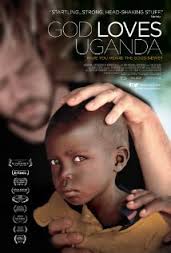
Film Review: God Loves Uganda

God Loves Uganda Cover

God Loves Uganda — a faulty premise that neglects important details and falls for grandiose stereotyping.

This documentary film by the acclaimed director Roger Ross Williams is a story about the complex mix of homosexuality, faith and politics in Uganda. He sees it as religious fanaticism stoking the flames of hatred and forcefully blames the influence of American evangelicals as the root cause of Ugandan homophobia.

His documentary thesis is supported by filming a devoted group of followers, and highlighting one of their former leaders, Lou Engle, from the International House of Prayer — an unaffiliated charismatic community located in Kansas City.

Read more

The Public Reader in the Church

The role of the public reader in the earliest diasporan Church, how the language changed over time, and the new problems it created.

Origen on Knowledge

A helpful guide for anyone reading Origen and getting stumped over his semantically diverse theories of knowledge.
Many historians and academics rank the third-century Christian theologian and thinker, Origen, as one of the best earlier Christian writers. He was steeped in Greek literature, structure and thought. Not only this, but his zeal for knowledge was wrapped in sincere piety. These characteristics were reflected in his writings.
This combination is especially found in the catena ascribed to him on I Corinthians.1 One is hard-pressed to comprehend the semantics of his knowledge words. This applies to the majority of his other works as well.
As a reader and translator of Origen, one must have a precise understanding of the Greek system of knowledge. There are a number of words for knowledge in Greek and have different applications. Understanding these words in the original context is a gateway to Origen’s mind.
This article attempts to unlock the words of knowledge in order to better understand Origen’s text. The beginning is difficult and complex for the English reader to understand but the end is rather simple. Origen wanted to know things in such a way that changed his worldview and his interaction with it. Studying was not simply for the sake of knowledge but becoming a better, more complete person.
Anyways, we will get into the details of his concept of knowledge starting now.

Read more

Evangelicals and Health Care Ethics

How health care ethics need to be ingrained in the fabric of the evangelical mindset.
Technology has introduced great breakthroughs on issues of life and death but has also naturally brought about new ethical issues that the traditional faith has not been prepared to engage in.
Most evangelicals are left with making life or death decisions, not on the basis of religious piety, but the insistence of economics or social convenience. They are game time decisions made in hospitals and doctors offices. These decisions are not considered the role of the church or faith. It is just what has to be done. Faith comes later.

Read more

The Language of Instruction in the Corinthian Church

A look at the ancient Jewish rite of instruction in Hebrew with an immediate translation into Aramaic or local vernacular. How it potentially impacted the earliest Corinthian assembly and how this rite evolved in the church.

The tradition of Jewish instructors speaking in Hebrew lasted for centuries. It is no longer practiced in synagogues today but was an important function in Judaism around the first-century. This little-known practice had an important part to play in the Jewish identity, and as will be shown, was a factor in the tongues conflict in Corinth.

In order to better explain this practice and make an association with the Corinthian gathering, we must go into ancient Jewish literature and examine citations from a number of prominent Jewish authorities. For those not familiar with Jewish writings outside the Bible, their observations are obscure on the first read and takes some contemplation.

Read more