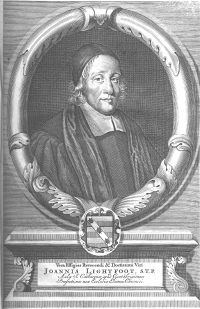
Lightfoot on the Problem Tongues of Corinth

John Lightfoot

A digitization of John Lightfoot’s Commentary on the tongues of Corinth.

John Lightfoot was a seventeenth-century English Churchman and Rabbinic scholar whose exegetical system was significantly advanced for that time period.

A small but brief window had opened in England during the Reformation for Hebrew studies, but the roadblocks to full public acceptance were great. England had long banished Jews from living in England1 during Lightfoot’s era. Later novels like Ivanhoe by Walter Scott, and Oliver Twist by Charles Dickens indicate negative perceptions concerning the Jewish race was strong. In light of these obstacles, Lightfoot began a very scholarly journey into the connection between Judaism and Christianity. He was in the wrong place at the wrong time doing a great job. He was a time anomaly. He should not have succeeded in this field of studies, but he did, and his work, though with some defects, has withstood the test of time.

Read more

Antisemitism in the Ancient Church

A brief look into the earlier Church, its treatment of outsiders of the faith, and Jews.

If anyone begins to read ecclesiastical writings with keen interest, it will be inevitable that one has to struggle with the antisemitic remarks in ancient Christian literature. As the researcher looks further into the issue, one finds a problematic and complex genre that requires untangling.

Antisemitism was a small part of a much larger problem. This fervor was not directly a problem with Jews but anyone or anything outside the Christian realm. The Church viewed anyone outside of the Christian community as less-than-human. One of the more obvious discriminatory references in ancient Christian literature and regular Greek ones was against the Scythians (ancient Russian people). Christianity’s political and military aspirations in some epochs sought to annihilate any person or population that did not embrace its message. They sometimes spared Jews due to their theological history. Although they often were exempted from the sword, they were second-class citizens.

At least they could tell their story of oppression. The many other pagans and whole unclassified communities who refused to convert have stories that will permanently remain unknown.

The narrative explained above is the dark side of our Christian heritage that forces any Christian theologian or leader to grapple with at some juncture.

Read more

Thoughts on Ecstasy, Private Revelation, and Prophecy

The use of private revelations, ecstasy and prophecy in the late Medieval European religious vernacular. What these words stood for, the growing opposition, and parallels to modern Christian mystics.

The societal and personal impact of these states has had a tremendous impact on European history. The mystical life was so widespread that contemporary Renewalists (Charismatics, Pentecostals, and Third Wavers) can use this era as a historical framework–a guide for improving the experience but more importantly guard against excess. The extravagance of the mystical experiences was one of the essential sources for the Reformation and forced a significant shift in European thought and life—an impact still felt today.

All of Europe, whether Protestant or Catholic, was immersed in a mystic lifestyle until the Renaissance slowly unraveled this social framework into a more rational sphere.

Read more

The Journey out of Christian Zionism

Picture of soldiers, Bedouin girls, military truck, and Judaen desert

Why I am no longer pro-Israel, nor pro-Arab, but pro-human.

The story about a Canadian Evangelical and apocalyptic Christian studying in Israel. How reality confronted imagination and stereotypes and won.

As my wife and I unbuckled our seatbelts on El-Al airliner and looked out the window, our imaginations ran wild. Little did we know the emotional and intellectual challenges that lay ahead.

We were on a one-year scholarship to attend the Hebrew University of Jerusalem in 1984. The stay in Israel was after three years of Bible College training. It was exciting to live and study in the actual place where most of the Biblical writings took place.

Read more