How the Bible should be revered but not worshiped, and it’s proper place in the religious life.
As a young child and at the point of first questioning matters of life, death, God, and everything in between, I discovered the Bible.
I thought this Book possessed a magical quality, so I slept with this heavy object underneath my head and expected spiritual wonders to happen. The next morning, my head hurt, and my ear was sore from rubbing against it.
As a young adult, the Bible expanded my mind about the world around me. It gave a positive framework of how to live.
A deep look at the data and debates about Montanism and speaking in tongues.
The association between Montanism and the christian rite of speaking in tongues is a matter of debate. The argument depends on which way one traces the lineage of speaking in tongues. The first one is through ecclesiastical literature, which chronicles the passing of this rite through the centuries. Its trajectory is the perceived miraculous speaking or hearing in a foreign language. Montanism does not play a role in the ancient church definition. The second and more prevalent way is to trace the lineage back to pagan Greek antecedents. This path leads to speaking in tongues as glossolalia. Montanism is one of the critical steps in this second order. Pentecostals and Charismatics take this second option further and claim Montanism and their alleged speaking in tongues as their historical parallel.
This article is an in-depth investigation to find whether Montanism plays an essential role in the earlier history of the christian doctrine of speaking in tongues. The provision of source texts, analysis, and comments follow the typical structure of the Gift of Tongues Project. Such details may seem boorish for the regular reader, but the lack of source literature and analysis are two of the most significant problems that have plagued the modern christian doctrine of tongues debate.
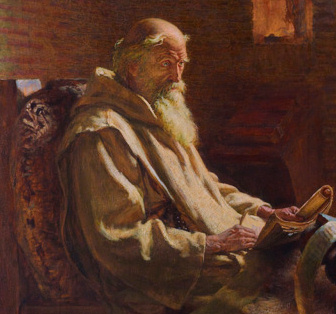
“The Venerable Bede Translates John” by James Doyle Penrose (1862-1932)
The Venerable Bede on reconciling ancient calendars and how he thought our 2 B.C. should really be 1 A.D.
Bede convincingly argued that our present 1 A.D. was incorrect by three years. What we understand as 2 B.C. is the correct year for Christ’s birth. He uncovered the fuzzy Church logic that created this problem. He cited a miscalculation that happened between 550 and 650 A.D. This error has caused calendar headaches ever since.
The Venerable Bede was an eighth-century monk who made a strong effort to collect all the calendar systems he knew about, whether historical or contemporary to his time, and reconcile them into one dating system. This endeavor sounds easy by today’s standards, but it was a massive undertaking.
If any discussion revolves around developing the yearly calendar system, his writings should be consulted. This study focuses on his works as it relates to Christ’s birth, but other pertinent dates fall in as well.
How did he arrive at this conclusion? He did it by comparing different calendar systems and then developing two new time systems – one of them closely parallels the A.D. system in use today.
A translation of Thomas Aquinas on I Corinthians 14:27-33 from the Latin into contemporary English.
Translated from the Latin text: Reportationes 088 R1C cp 14 Pg. 390 lc6
I Corinthians 14:27–33
The Apostle maps out here how they ought to conduct themselves in regards to the gift of tongues. In respect to this, he does it in two ways. With the first he shows in which they ought to utilize the gift of tongues. With the second when they ought to cease from [its] use. In that place it says, “But if there will be no [interpreter], etc.” he then says, with the first, that the manner in which the gift of tongues ought to be applied is to be such among you that “If any,” which is if someone should speak in a tongue, that is he is going to narrate visions or dreams, of such things, a speech probably cannot be done by many on account of the occupation of time in tongues and no place remains for the prophets and generates confusion but, “Let it be by two,” that is by two persons, and if necessary it ought to have been done according to “the most three,” that it should be enough at three.
A translation of Thomas Aquinas on I Corinthians 14:23 — 26 from the Latin into contemporary English.
Translated from the Latin text: Reportationes 088 R1C cp 14 Pg. 389ff lc5
I Corinthians 14:23 – 26
A gloss suggests that perhaps in this place a different reason commences for making clear the purpose. But according to what has been written, it is not, except for one reason which has been settled and as it were, he is in the middle of his argument, namely that prophecy is more valuable than that to which the gift of tongues is ordained for.
A translation of Thomas Aquinas on I Corinthians 14:18 — 22 from the Latin into contemporary English.
Translated from the Latin text: Reportationes 088 R1C cp 14 Pg. 389 lc4
I Corinthians 14: 18 – 22
Ic4. This apostle shows the excellency of the gift of prophecy over the gift of tongues by the reasons which had been established on his own part. And concerning this he does two things: first he brings thanks concerning the gift of tongues which had been given to him by God. Secondly, he proposes himself as an example for them. Where it says, “But in the Church I wish, etc.” He goes on to say, “I give thanks, etc.,” as if he was to say, “Therefore I do not despise the gift of tongues, because I say that the gift of prophecy is more excellent but [tongues] ought to be retaining a high value as well.”
A translation of Thomas Aquinas on I Corinthians 14:13-17 from the Latin into contemporary English.
Translated from the Latin text: Reportationes 088 R1C cp 14 Pg. 388 lc3
I Corinthians 14: 13 – 17
1C3. The Apostle above demonstrated the excellency of the gift of prophecy over the the gift of tongues by having taken up the rationale by reason of exhortation’s function. In fact he showed the same thing by reason of the function of prayer. For we perform these two things by means of a language, namely prayer and exhortation.1