How Big Tech and its Techno-Liberalism ideology is shaping the future for labour, infringing on national sovereignty, and transforming health care.
Part 2 of a five-part series examining the influence of Big Tech and its Techno-Liberalism ideology from philosophical, religious, and political perspectives.
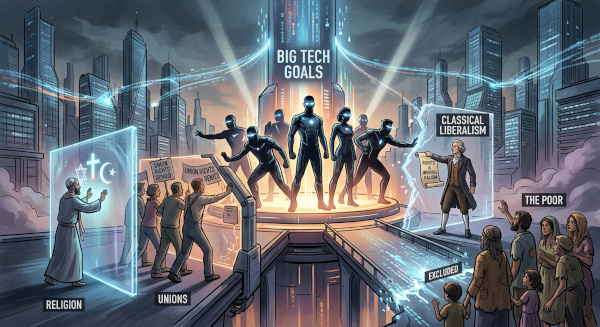
Big Tech and its Techno-Liberalism ideology have permeated almost every area of human life and are the cause for the most radical societal shift since the Reformation. This article is the second part of a series that examines various perspectives on the movement from its rise to its end.
Table of Contents
The Impact of Techno-Liberalism on Labor
The American Association of University Professors represents a universal union concern about the rise of the technological enterprises, their impact on employees, and the real problems they pose in an unregulated environment:
Currently in the United States, employers are introducing untested data-intensive technologies with almost no regulation or oversight, as former Federal Communications Commission Chairman Tom Wheeler documented. Workers largely do not have the right to know what data are being gathered about them or whether the data are being shared with others. They do not have the right to review or correct the data. Employers in many states are not required to notify workers about any electronic monitoring or algorithms they are basing decisions on, and workers do not have the right to challenge those decisions.1
Unions see this movement as undermining society.2
Amazon, for example, uses Gig workers for delivery in its Amazon Flex service. The person is self-employed and uses their own vehicle and gas to deliver to predetermined points of call. The Amazon Flex service advertises that one can make up to $27.00 per hour (the ‘independent operator’ must use their own vehicle, pay for gas, vehicle insurance, and cover their own income tax from this). There are no benefits or holiday pay. You can choose your hours.(3) If you are sick, have an accident, or get injured on the job, or if volumes are low and there is no work, that is your problem, not Amazon’s. You can leave Amazon, or Amazon can discharge you for no reason at all.
Adam D. K. King, Assistant Professor, Labour Studies Program at the University of Manitoba, believes gigification is causing a significant problem in Canadian labour and society:
Research from Canada and the United States suggests gig companies avoid paying millions of dollars in payroll taxes and workers’ compensation premiums. This not only deprives workers of protections, but also drains revenues from vital social benefit programs, such as unemployment insurance.3
This influence is pushing Canadians towards a gig economy that will return Canadian society to the pre-1945 era, before there were stringent labour laws and union representation. These changes are reversing all the equity and rights that the Canadian working class has fought for.
The Impact of Techno-Liberalism on National Sovereignty
This corporate economic theory is having an impact on national sovereignty. Facing massive upgrade costs and lacking technological expertise, Governments are turning to Amazon, Microsoft, Google, Oracle etc., to implement solutions for cloud computing, storage, AI, and security. For example, the British Government signed a $600 million, three-year contract with Amazon Web Services (AWS) to outsource the UK Home Office.4 Google inked a 600 million dollar deal with the UK Ministry of Defence so that:
Working people will be more secure as the UK Armed Forces prepare for the new era of threats with a major deal with Google Cloud for the latest security technology – strengthening collaboration between the UK and US.5
Other countries such as Australia, Denmark, and Poland have already moved to this system.
Surprisingly, the Israeli Government has also joined this digital sovereignty alliance. They have a history of aloofness to the US and other Governments out of fears for self-preservation.
The Canadian Government has spent over $1 billion since 2021 on cloud services.6
Highly sensitive Government data is on the cloud, and there are hopes that all information is on servers within the host country, though not necessarily. Geolocation and outsourcing raise questions about national sovereignty. The cloud storage companies are US-based. The current US legislation, called the Cloud Act, gives the US Government power to access data by American-based companies under certain circumstances.7
The big hyperscalers would reply that encryption and geolocations are their commitment to secure data. Data encryption is the responsibility of the host government, and the cloud server company does not have access to the data contents; only the host Government and its programmers do. They merely provide a container for the data and supply whatever functions or specialists as requested. AWS is in the process of creating a subsidiary residing in Germany, alleviating fears of overseas control.8
This circumstance raises very big questions. What happens if the US Government forces one of these companies to forward confidential information? What if a country is at odds with the US? Will the American Government order the shutdown of the opposing country’s servers or inject false data into their systems until their international conflict is resolved? Last of all, what happens if a country fails to pay?
No information is found on protecting the server information from being blocked by the US or a supplier withholding access due to non-payment.
However, the US Government and its Big Tech allies have final control. Big Tech created and sustains the platforms that military devices such as the F35 fighter jet utilizes regardless of the country owning them. When a country acquires advanced equipment, they are also securing communication technologies, parts, satellite access, and upgrades with their purchase. Any direct opposition to the United States and its ambitions could theoretically cause these pipelines to be turned off,9 which would render any high-tech software or machinery useless.
The Ukrainian war is a smaller indirect example of this problem. Even though the following is not American Government intervention, it does demonstrate how one external person or organization can leverage power in an international dispute. Elon Musk’s Starlink is essential for military surveillance and communication, and gives this small country a counter to Russia’s might. At one heightened instance, the Ukrainians were advancing deep into Russia’s defences, causing Musk to fear that the Russians might use their nuclear arsenal in response. This alleged fear prompted Musk to deny Ukrainian access to the Starlink network for a few days and consequently delay any Ukrainian advance, diminishing any chance of Russia using their nuclear arsenal. The official line was technical difficulties, not Musk’s existential angst. Regardless, whether it was true or not, Musk and his corporation have the power to change outcomes of a sovereign nation.10
The United States Government also later used the threat of withdrawing Starlink communication access as a negotiating tool to give the US access and ability to extract minerals in the Ukraine.11
The Impact of Techno-Liberalism on Health Care
There are many aspects about the intersection between health care and technology, especially CRISPR, a gene editing solution, and the role of Artificial Intelligence in administration, diagnosis, treatment, and medical solutions. These promises are building hope for a healthier and more prosperous future, but they also create new sets of problems.
Exorbitant cost is the first challenge. Many CRISPR and other advanced solutions can cost up to 3.5 million per person to deal with conditions such as hemophilia.12 These solutions are unaffordable to most country’s health systems or private insurers.
Tech companies, aware of this expensive proposition, promise that AI will help in early detection of problems before they require such costly intervention, freeing up funds for more tech infrastructure, complex equipment, and tailored pharmaceutical therapies. This philosophy reshapes the medical community from focusing on treating a malady to preventing it in its early stages.
Hospitals around the world, lacking tech specialists and economic resources, are now entering into lease agreements for high-end equipment and outsourcing their IT infrastructure to achieve these ideals, which adds to their expenses. They hope that these high up-front costs will yield future savings from reduced labour and fewer critical health interventions.
The focus here is on the algorithms and frameworks that are beginning to control the health system, specifically Electronic Record System software and its infrastructure. The major players in this are US-based companies such as Epic Systems, Oracle Health (formerly Cerner), and Meditech.13
The systems incorporate Artificial Intelligence, which requires a high monetary, labour, and infrastructure investment. This situation has caused many medical institutions, such as St. Luke’s University Health Network, located in the US, to outsource this function because they are not in the business of heating and cooling, and server and storage business.14
Outsourcing is especially pertinent to countries outside the US, where data sovereignty issues are a serious problem.
Just as important is the impact of the ERS on the health care system. It shifts it from a patient-centred to a data-centric model focused on time efficiency, data-informed insights, and fulfilling database requirements.
Eric Reinhart, a political anthropologist, psychiatrist and psychoanalyst, is critical of the overarching governing presence of the new ERS systems:
The problem is that when it is installed in a health sector that prizes efficiency, surveillance and profit extraction, AI becomes not a tool for care and community but simply another instrument for commodifying human life. …The real world of the US healthcare system doesn’t generally work that way. Each technological advancement that could free up physician time has instead tightened the productivity ratchet: these “efficiency gains” have simply been used to squeeze more visits, more billing, and more profit out of every hour. In other words, whatever time and energy technology saves, the system immediately recaptures them to maximize profit.15
The following conjecture is likely where this is all heading.
Studies have indicated that for every hour a doctor spends treating a patient, two hours are spent in entering data,16 though an AI scribe addition can reduce it by 30% or more.17 Imagine a situation in which a doctor, nurse, and radiologist all have to spend significant time entering or validating data on a client’s condition in a hospital ward. They would constantly have to feed it into their database system which takes away time from patient care. This scenario is tedious, especially if the patient’s condition changes hourly.
The AI-guided system would recommend primary treatment options or rudimentary diagnosis. This system would be structured by previous similar cases, hospital or medical agency policy, liability, labour relations, treatment effectiveness, economics, end-of-life assessments, and, in some countries such as Canada, whether to recommend assisted dying, and the allocation of resources and time.
The AI solution would then be the final arbiter in all proceedings with supervisors and managers above the front line ensuring the workers entered the data correctly and acted upon the conclusion by the AI, and if not, would have to provide a reason for their contrary actions, and possible suspension or dismissal for not following the hospital or medical agency guidelines.18
Employees and middle managers cannot question the pre-built process. Their job is to ensure that it is correctly followed. Any procedural problems would have to be updated by the software engineers as instructed by their team leader.
The primary priority is no longer patient care but ensuring the algorithm was followed in every step.
Big Tech is also rewriting financial and economic markets. This is briefly covered in Algorithmic Governance: Rules, Gamification, and Resistance Across History
Conclusion
This is part two of a five-part series. Next up is part 3 When Technology Becomes Belief.
Here are the other parts:
- Part 1. Big Tech and the New Social Order
- Part 4. Christians in the Age of Techno-Liberalism
- Part 5. The End of Techno-Liberalism (incomplete. To come soon)
See the Technology section of this blog for more articles.
- Artificial Intelligence and Academic Professions accessed December 15, 2025
- Corporate Underminers of Democracy 2025
- https://www.talentcanada.ca/canada-post-strike-highlights-labour-struggle-over-gig-economy-and-precarious-work/; this is partially taken from my article on a different blog, Canada Post and CUPW Negotiate Future Delivery Model Amidst Gig Economy Competition
- https://www.techmonitor.ai/hardware/cloud/aws-contract-home-office?cf-view. Accessed November 29, 2025
- https://www.gov.uk/government/news/security-delivered-for-working-people-as-uk-us-ties-strengthened-with-new-google-cloud-partnership-for-classified-information-sharing. Accessed November 25, 2025
- https://globalnews.ca/news/11436395/department-of-national-defence-us-cloud-services/
- https://www.justice.gov/criminal/media/999616/dl?inline; https://www.congress.gov/crs-product/R45173; https://www.osler.com/en/insights/updates/data-sovereignty-in-light-of-the-cloud-act-back-to-the-future/; https://www.politico.eu/article/donald-trump-eu-internet-europe-us-trade-war-data-cyber/; https://www.techradar.com/pro/eu-efforts-to-reduce-reliance-on-us-hyperscalers-under-fire-from-those-it-wants-to-help
- https://upcloud.com/blog/why-us-hyperscalers-fall-short-on-european-data-sovereignty/
- Henry Farrell and Abraham Newman “The Enshittification of American Power” as found in Wired. 33.09. NP.
- https://www.theguardian.com/technology/2023/sep/07/elon-musk-ordered-starlink-turned-off-ukraine-offensive-biography
- https://www.reuters.com/business/us-could-cut-ukraines-access-starlink-internet-services-over-minerals-say-2025-02-22/
- https://pmc.ncbi.nlm.nih.gov/articles/PMC10678297/
- Globally: https://www.ehrinpractice.com/largest-ehr-vendors.html | in Canada: https://www.definitivehc.com/blog/top-canadian-hospitals-ehr-vendors
- https://www.healthcareitnews.com/news/solving-cloud-computings-capex-vs-opex-conundrum-once-and-all
- https://www.theguardian.com/us-news/ng-interactive/2025/nov/09/healthcare-artificial-intelligence-ai
- https://pnhp.org/news/physicians-spend-two-hours-on-ehrs-and-desk-work-for-every-hour-of-direct-patient-care/
- https://pmc.ncbi.nlm.nih.gov/articles/PMC12460601/
- https://tateeda.com/blog/why-healthcare-ai-fails-and-how-to-build-it-right

About Charles A. Sullivan
Charles Sullivan is fascinated by the spread of ideas, from ancient texts to modern issues. He particularly examines how faith, spirituality, mysticism, politics, and technology have evolved and influence us today.