Unearthing the mysterious tongues of Corinth through the framework of Jewish liturgy reveals an understudied field with significant scholarly implications.
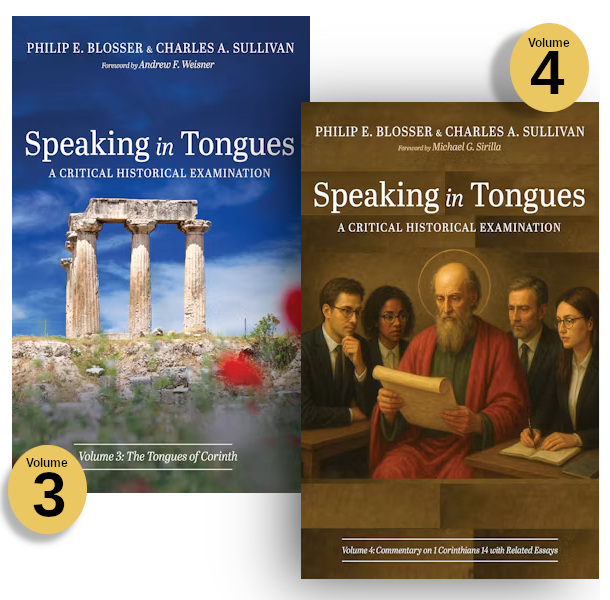
Volumes 3 and 4 of Speaking in Tongues: A Critical Historical Examination were dedicated to unearthing the historical connection between the fledgling Hellenist Jewish Messianic Assembly of Corinth and the ancient Jewish rite of speaking and interpreting. This essay is a supplement to the books and will dwell into this theory with introductory details.
1. INTRODUCTORY NOTES
The Jewish liturgical perspective on the Corinthian tongues is not a novel one. Initial historical evidence from Jewish, Catholic, and Protestant literature supported a further investigation. The results provided a richer history than Glossolalia or a private prayer language.
It is a solution that requires fewer words, less rhetoric, and fewer esoteric insights than the alternatives.
The liturgical functions of the speaker, interpreter, reader, and chanter were already established for centuries in the Jewish liturgy before the Messianic Jesus branch was born and began to shift into Christianity. Paul’s description of the Corinthian assembly demonstrates the continuation of this rite. The Church then adapted and evolved this liturgical structure throughout the centuries.
The Gift of Tongues Project1 and its accompanying book series2 consistently demonstrate the neglect of ancient Christian literature in studies of the doctrine of tongues. The exclusion of Jewish literature and customs from interpretations of early Christian rites reflects the same broader pattern.
Paul’s reference to speaking in tongues in I Corinthians is puzzling for readers because he was building on topics that his readers readily understood. Today, we do not possess those assumptions and have to diligently work to fit the pieces together.
Such an idea of Jewish underpinnings posits a number of problems. Regardless of any historical theological subject, one has to turn to fourth century documents and backtrack from there. We have little to no first century evidence of the Jewish liturgy at the time of Paul, except for Paul’s references. Indeed, Paul’s statements should be read as demonstrations of a Jewish liturgy that were in an earlier stage of evolution. Because of the lack of first century material, the researcher can only state theories, not realities. 3
Central to this theory is the contention that the movement is best interpreted within a Jewish rather than a Hellenistic context. The implications and tensions of this position are examined later in the essay.
Then, there is the question about why so few Church writers gave attention to the tongues of Corinth, and when they did, there was no connection to the Jewish liturgy.
Why? The ancient church writers were emphatic about moral and character development. Understanding historical context had small importance in most of their writings. The exceptions were Epiphanius and the Ambrosiaster writings who did refer to the liturgy. Secondly, with the exception of Origen, Epiphanius, and Jerome, there was little or no educational pursuits of Hebrew or Jewish thought within the Church, especially in the fourth century which formed the nucleus of a universal Christian institution.
These fourth-century Hellenized Christian writers relied on their backgrounds in Greek rhetoric, philosophy, and history with no reference to Judaism. Added to this was competition for a captive audience between the two similar faiths. This open competition brought the famed orator, John Chrysostom, to pronounce bold judgments against the Jewish faith to stem attraction to them. These actions further distanced Judaism from Christianity.
The Latin leaders followed in the same traditions established by the Greek Christians.
The approach requires a discovery of Paul from a combination of Judaism and ancient Church literature as the primary catalysts with Hellenism following in a close third. Does this interpretational system work for understanding the tongues of Corinth? Yes, and Corinthian tongues as a liturgical problem is the best theory among the others.
2. THE THREE THEORIES ON THE CORINTHIAN TONGUES
The interpretation of the Corinthian tongues is typically dominated by two views: glossolalia and divine prayer language. Yet both are modern constructs that lack a complete historical grounding. A third, rarely emphasized alternative—a liturgical problem—remains available, and it forms the central focus of volumes 3 and 4 of Speaking in Tongues: A Critical Historical Examination.
We will take a brief look at their histories and compare.
a.) The Glossolalia Framework
The description of the Corinthian rite of speaking in tongues as Glossolalia is the most common theme, and in intellectual circles, the only one. There is no alternative in most contemporary minds, academic books, or scholarly works.
The introduction of the glossolalia theory occurred in the late 1700s and began to take shape in the 1830s within German circles, expanding from there. This beginning and entrenchment are well documented on my blog, in the book Speaking in Tongues: A Critical Historical Examination, Volume 1, and in our video on the origins and rise of Glossolalia.
The doctrine of Glossolalia establishes its theory through classical Greek sources, beginning with the Delphic prophetesses who yielded mystical verses in earlier centuries before Christ, and later with the second-century fringe Christian group known as the Montanists, as key evidence. The Greek word for tongues, γλῶσσα (glōssa), does not significantly appear in any of their source texts.
There are few references to Christian literature in the Glossolalia doctrine, and the ones chosen are highly selective and omit the larger corpus available. Also, the theory failed to cite important pieces of historical Christian literature because they did not fit into or confirm its narrative. The academics who founded this doctrine failed to resolve this tension.
This absence demonstrates a contemporary flaw in New Testament exegesis. One that exclusively looks at classical Greek events, people, and culture for interpretation, excluding everything else. The tongues of Corinth are one of those casualties.
This problem traces back to the 18th century and later German academics. These religious scholars had a bias toward Greek classical sources rather than Christian or Jewish texts when interpreting Biblical passages.
German scholarship was considered the centre of the Christian academic universe from the late 1700s onwards. Their influence is immeasurable.
They were very successful in establishing the glossolalia framework using a small subset of Greek sources, and its conclusions still influence us today.
The German pre-Nazi academic world hyper-emphasized the Protestant tendency of any Catholic practice as myths and legends with no historical value. 4 Though some may contest this statement as too broad and would prefer a softer version: German higher criticism prioritized historical and linguistic analysis of biblical texts over received ecclesiastical interpretations, using Greek and ancient sources to reconstruct the earliest stages of Christian scripture.5This approach paints an alternative pathway that is not consistent with Christian history.
Antisemitism existed already in German religious studies for centuries but accelerated under Nazi rule. This cumulative problem extends to the study of Corinthian tongues. An example is the Theologisches Wörterbuch zum Neuen Testament, whose translation is called the Theological Dictionary of the New Testament. This series is the gold standard for any university-level theological studies.
The editor of the Theological Dictionary of the New Testament, Gerhard Kittle, was anti-Semitic and sought to de-Judaize the Scriptural narratives. He was arrested for war crimes at the end of World War II. 6
This bias was reflected in the TDNT entry on tongues which contains one of the most quoted citations by third-party authors, commentators, and scholars. The author for the tongues entry in this dictionary was Johannes Behm.
Behm’s article, γλῶσσα, in the TDNT, failed to give a comprehensive account of tongues in the early Church. The author does quote Origen from the book, Against Celsus, and Irenaeus, Against Heresies, to support his view that the Christian gift of tongues parallels similar phenomena in different religious systems and various periods. 7 However, Behm failed to point out that in both his examples, the word γλῶσσα (glōssa) does not even occur and neglected the use of γλῶσσα (glōssa) employed by Origen and Irenaeus elsewhere. He cited the comic Greek playwright Aristophanes’ work, Frogs, to reinforce his argument that speaking in tongues was a form of syncretism with Hellenism. How the Frog’s text applies to ecstasy, a mystical tongue, or Corinthian tongues is a stretch of faith that neither linguistically or contextually provides any evidence.
He was relieved as a professor at Friedrich Wilhelm University of Berlin after the Second World War because of his Nazi sympathies.8.
His citation is in the 1979 edition of the ubiquitous Greek Dictionary, Bauer-Arndt-Gingrich’s A Greek-English Lexicon of the New Testament and other early Christian Literature: Fourth Revised.9 This dictionary is a primary translation aid for anyone reading or studying New Testament Greek. On the topic of tongues, this dictionary fails to reference significant ecclesiastical texts or deal with the tension between Glossolalia and the traditional Church position. Oddly, Behm’s reference mysteriously vanishes with no explanation in the 2000 version.10.
The influence of Hellenism on early Christianity and first-century Judaism is important but overdone—a statement echoed by many scholars who study Greek and Jewish texts.
Peter J. Tomson, a specialist in Patristic and Rabbinic writings strengthens this observation:
The interest in Hellenism as a political and cultural phenomenon was a novel feature of the nineteenth century historical scholarship. . . The result was an explanation of Paul’s universalism from Hellenistic rather than Jewish religiosity.11
He noted that exclusively studying Greek and ignoring Hebrew or Aramaic texts is a modern Western oddity:
In other words Paul’s teaching on the Law is to be explained within the religious and social context of his own time as revealed in contemporary sources. But curiously enough, Greek rather than Hebrew and Aramaic sources were thought really relevant, and halakhic sources least of all.12
This sentiment is also echoed by Julio C. Trebolle Berrara, a well-regarded professor of Hebrew and Aramaic and author of the respected and popular book, The Jewish Bible and the Christian Bible: An Introduction to the History of the Bible.
. . .Paul and Judaism do not represent two opposing worlds. It has even been possible to state that Christianity, for Paul, is not a new religion, but the culmination of Judaism. . .13
The Jewish background occupied the mind of the influential liberal historian, Adolf Harnack. He is a surprising source because he was a strong proponent for the Hellenization of Christianity. He recognized the Jewish influence of the Gospels separate from Hellenistic influence at Christianity’s formative stage.
The Gospels are not “party tracts” neither are they writings which as yet bear the radical impress of the Greek spirit. In their essential substance they belong to the first, the Jewish, epoch of Christianity, that brief epoch which may be denoted as the palaeontological.14
He believed the assimilation into Hellenism happened in the second century.15
The Hellenistic approach significantly distorts the history of the Christian doctrine of tongues.
This environment makes Pauline studies a modern abstract journey devoid of proper documentation from a corpus of Jewish or Catholic literature. Everything is seen from a lens of Hellenism or from contemporary Catholic or Protestant experientialism.
The problem of Jewish literary neglect was also found in Catholic studies as well. For example, the Irish Catholic priest, J. L. Meagher, who traveled extensively in the Middle East to rediscover the Jewish roots and apply it to a Catholic framework. The results demonstrated the primacy of Christian literature over anything of Jewish origin:
Bible and Talmud, both written by Hebrews, differ in a striking degree—one is the product of inspired men, through whom God spoke to the world, the other was written by men of an outcast nation, spiritually dead, absolutely divested of every spark of supernatural faith. One pulsates with life; in every page you see, in the original, the foretold Redeemer, the face of the Holy Ghost; the other, the Talmuds, show the heart of a race [Pg. 52] punished for idolatry by the Babylonian captivity, and for the crime of killing their Messiah driven by the Romans into all the earth fulfilling these words, “We will not have this man rule over us.” “His blood be on us and our children.16
These factors have led most advanced Christian readers to think the Church was silent on speaking in tongues and a solution could only be found in classical Greek instances.
b.) The Pentecostal Framework
Charismatic, Pentecostals, and Third-Wave church followers believe Paul supports speaking in tongues as a private prayer or angelic language.
The Pentecostal doctrine of divine language began shortly after 1906 due to the missionary tongues crisis. Pentecostals initially held to the traditional doctrine of tongues as the supernatural ability to speak in a foreign language for worldwide evangelism. With the outbreak of tongues within Holiness-influenced groups such as Azusa Street and elsewhere, select followers, such as Alfred Garr, went overseas with the expectation of immediately speaking in a foreign language. Upon arrival, they did not have this miraculous ability. This crisis forced the early Pentecostals to either admit they were in error or redefine the experience.17
They chose the second option to redefine using the German academic influenced dictionaries and commentaries. Philip Schaff, F. W. Farrar, and Conybeare and Howson were especially dear to their revision. The early Pentecostal pioneers spiritualized the glossolalia doctrine to one of a heavenly, divine, or angelic prayer language. Such a doctrine did not exist before this era. There are numerous articles on my blog and in the book, Speaking in Tongues: A Critical Historical Examination. Volume 1, that substantiates this premise.
Early Protestant English translations, especially the Geneva Bible, and later the King James Bible, included ‘other tongues’ in their Corinthians translations as a polemic against the Catholic Church on their stance of Latin being the exclusive source of worship and instruction. Even though the adjective ‘other’ as in ‘other tongues’ does not exist in the Greek, later readers and especially literature from the Spirit-led movement gave this a mystical nuance and omitted its original intention.
c.) A Jewish Framework
The liturgical theory relates to Paul attempting to resolve a Jewish conflict over who speaks, teaches, recites prayers, interprets, and instructs the lay person in the original Hebrew and/or Amamaic to a predominately Hellenistic Jewish audience,
The ancient Church leader Ephipanius described the Corinthian assembly as rivalling Greek ethnic groups disputing over Jewish liturgical rites, specifically the interpretation of the Hebrew into an approved Greek vernacular. In Epiphanius’ mind, it was an ethnic and liturgical conflict with no correlation with Pentecost or any association with the miraculous.
The seventeenth-century Protestant Hebraist scholar, John Lightfoot made definitive connections between Corinth and the Jewish liturgical rites:
We are of the opinion, therefore, nor without reason, that unknown language which they used, or abused rather, in the church, was Hebrew; which now of a long time past was not the common and mother tongue, but was gone into disuse; but now by the gift of the Holy Ghost it was restored to the ministers of the church, and that necessarily and for the profit of the church. We inquire not in how many unknown languages they could speak, but how many they spake in the church; and we believe that they spake Hebrew only.18
He further writes that understanding Hebrew unlocked the mystery tongues of Corinth. His base premise was correct about the sacredness of Hebrew in the Corinthian context, but his assertion that it is the miraculous restoration of Hebrew oversteps the boundaries of the source texts.
There is a modern trend that is more balanced. Peter J. Tomson and many of his fellow academics working on Patristic and Rabbinic writings press for a more Jewish-centric framework for understanding the New Testament and Paul’s writings. They argue that Jewish literature from Qumran to the Talmud and later should be of primary importance to understanding Paul.
Notable researchers such as David Bivin, the late professors Dr. Robert Lindsay, and the renowned David Flusser, an Israeli professor of Early Christianity and Judaism of the Second Temple Period, regard the majority of the New Testament as a continuation of Jewish literature.
Gedaliah Alon, an award winning Israeli historian, and author of The Jews in their Land in the Talmudic Age (70-640 C.E.) integrated both Rabbinic and Patristic literature in his coverage. He demonstrated early Christianity was a Jewish sect until at least after the first century.19
Alfred Edersheim, a Jewish convert to Christianity, best known for his monumental work, The Life and Times of Jesus the Messiah, makes such connections from Christianity to Judaism in careful detail.20
Pamela Eisenbaum, author of the recent and popular book, Paul was not a Christian: The Original Message of a Misunderstood Apostle, strongly asserts that the word Christian was not a normative term during Paul’s time. One must understand it as a Jewish movement in this time period.
But in the first century the letters could not possibly have functioned as a marker distinctive of Christian identity. First, there is the obvious reason that there was no such religious category “Christian.” As far as can be determined by historians, archaeologists, and biblical scholars, there were no distinctively Christian institutions, buildings, or symbols in the first century, and few scholars believe that Christians did not materially distinguish themselves until the late third or early fourth century.21
And then she added:
Moreover, Paul’s letters would have been regarded as Jewish by other Jews of the time, including Pharisees. They might not have thought the letters contained correct views, and they might well have thought Paul a bad Jew, but a Jew nonetheless.22
The information so far demonstrates Jewish liturgy has more substance than Hellenistic antecedents but, of course, many readers remain skeptical and want more substantiation. So we will dig deeper for more clues.
The evidence of a Jewish centric interpretation also falls on Paul’s character. He was a multilingual person who thought and wrote as a traditional Jew.
He was adamant about preserving his Jewish identity. He went to great lengths to appeal to his brethren in Jerusalem and beyond about his Jewishness and even performed the Nazarite vow: a purification rite that could last up to and over 30 days.23 He was not abandoning nor diluting the Jewish faith as his accusers suggested in the Book of Acts. The denunciation of his alleged syncretizing Hellenistic thoughts and practices was an especially sensitive topic around Jerusalem and the Dead Sea communities. This accusation was cause for some to actively pursue and try to kill him.24
Furthermore, he was trained as a Jewish leader under Gamaliel, which entitled him to learn or improve his Hebrew language skills (for legal and religious reasons within the Jewish community), and Greek (for civil and legal representation with Greek authorities). An important piece of evidence was that he spoke in Greek with a Roman commander (Acts 21:37). He lacked the ability to write, which is why he used an amanuensis for his letters.25 This was a common practice in that day to have a specialist write a dictation. His hometown of Tarsus, likely was a community of Aramaic speaking Jews. So Paul at least knew three languages, maybe even some familiarity with Latin. This multilingual ability was why he could boast to the Corinthian assembly, “I thank God that I speak in tongues more than all of you.”26
An argument then arises that if the earliest assemblies of Christ followers were Jewish, why did they not meet or create synagogues instead of assemblies? Assemblies suggest that the movement started in Hellenism, not Judaism.
One must be cognizant that Paul could not refer to Corinth as a synagogue because there were legal, political, and educational obligations within the Roman empire that every synagogue employed. The Jewish splinter group of those who followed Christ did not have that authority, so Paul used the word ‘ecclesia,’ ‘assembly,’ instead. He did not mean it as a separate entity from mainline Judaism or the development of a new Greek movement.27
This idea of an assembly was not universal. James, the brother of Jesus, infers a synagogue connection with the earliest Jewish believers within the land of Israel.28 This type of association reinforces that the earliest movement during Paul’s time was a Jewish one.
However, there was division in this new movement about its identity, especially in the diaspora: was it Jewish, Greek, or an admixture? It is an issue that touches on the level of Hellenistic influence and the embracement of Jewish customs. Almost immediately after Pentecost, the Jewish contingent of Christ followers believed that Gentiles needed to become Jews first through the rite of circumcision.29
The tension was so palpable that Peter needed a divine dream to break the barrier between Jew and Gentile. The crisis threatened the existence of this early movement and required a special council to resolve it. The Jerusalem council outlined in the Book of Acts concluded that Greek converts to the Jewish message could remain Greeks, provided they met a few requirements, while the Jew remained a Jew. The decision ends with keeping the ancient Jewish constant of reading the Law on the Sabbath in the synagogues found in every city in their known world.30
Still, even with all these debates and rancour, Peter later fudged on the issue and removed himself from any contact with Gentiles.31 There is no record that this internal conflict was entirely resolved. It may be that after the destruction of Jerusalem and the many Jews brought into slavery, and Jewish believers fleeing from Jerusalem before the siege, the choice of non-contact with gentiles was no longer tenable.
The important factor here is that the Jerusalem council reinforced the rite of reading the Law. In other words, they retained the rudimentary customs of the Jewish world. They did not write how the reading was applied or spoken, but such a ruling would have been respected by the Corinthian assembly and by Paul. The problem facing Paul and the Corinthian assembly was that there were no detailed guidelines for how this worked.
The seeds of Christianity contained a Jewish identity until at least the Bar Kokhba revolt that finished in 135 AD.32 This battle is the last time a Jewish Bishop presided in Jerusalem.33
Pauline tension over the Law, a topic in itself, is understood as part of a Jewish in-house discussion. His views are not a break away Greek invention.
Now that we are finished with Paul and his Jewish identity, it is time to move on to how it applied in his era and in the earlier Church.
This is found in Part 2 A Survey of Christian Texts on the Liturgy from Corinth Onwards
© Charles A. Sullivan
- https://charlesasullivan.com/gift-tongues-project/
- The books are available at Amazon, Wipf & Stock, and other large book retailers
- See also Michael Graves. The Public Reading of Scripture in Early Judaism. JETS Magazine, September 2007. Pgs. 467-487. He gives a similar caution.
- See my article The Historical Rejection of Patristics and its Legacy
- The result of an analysis by ChatGPT.
- See https://auslegungssache.at/7674/die-nazis-im-ersten-band-des-theologischen-woerterbuchs-zum-nt/#fn.9 Accessed April 10, 2024
- He was dismissed by the military Government after the war in 1945. He was a signatory of the declaration of allegiance to Adolf Hitler by professors at German universities and colleges in November 1933. https://de.wikipedia.org/wiki/Johannes_Behm
- A Greek-English Lexicon of the New Testament and other early Christian literature: Fourth Revised. Walter Bauer, ed. Translated and augmented by F.W. Gingrich and Frederick W. Danker. Chicago: University of Chicago Press. Second Edition. 1979. Pg. 162.
- A Greek-English Lexicon of the New Testament and Other Early Christian Literature [2000]. Frederick W. Danker ed. Chicago: University of Chicago Press. 2000. Pg. 201
- Peter J. Tomson. Paul and the Jewish Law. Maastricht: Van Gorcum. 1990. Pg. 31
- IBID Tomson. Pg. 4
- Julio C. Trebolle Bararra.The Jewish Bible and the Christian Bible: An Introduction to the History of the Bible. Translated by Wilfred G. E. Watson. New York: Brill. 1998. Pg. 32
- Adolf Harnack. What is Christianity: Lectures Delivered in the University of Berlin during the Winter-Term 1899-1900. Translated by Thomas Bailey Saunder. Second Edition. Revised. New York: G. P. Putnam’s Sons. 1908. Pg. 23 as found at https://ccel.org/ccel/harnack/christianity/
- “The influx of Hellenism, of the Greek spirit, and the union of the Gospel with it, form the greatest fact in the history of the Church in the second century, and when the fact was once established as a foundation it continued through the following centuries.” Adolf Harnack. What is Christianity: Lectures Delivered in the University of Berlin during the Winter-Term 1899-1900. Translated by Thomas Bailey Saunder. Second Edition. Revised. New York: G. P. Putnam’s Sons. 1908. Pg. 214-215 as found at https://ccel.org/ccel/harnack/christianity/
- James Luke Meagher. How Christ said the first mass, or, The Lord’s last supper. The rites and ceremonies, the ritual and liturgy, the forms of divine worship Christ observed, when He changed the passover into the mass. New York: Christian Press Association Publishing. 1908. Pgs 51-52
- https://charlesasullivan.com/9179/pentecostal-missionary-tongues-crisis/
- John Lightfoot. A Commentary on the New Testament from the Talmud and Hebraica: Matthew – I Corinthians. Grand Rapids: Baker Book House. 1979. Original Publication 1660. Pg. 256
- Gedaliah Alon. The Jews in their Land in the Talmudic Age (70-640 C.E.) Two Volumes. Translated and edited by Gershon Levi. Jerusalem: The Magnes Press. 1984
- Alfred Edersheim. The Life and Times of Jesus the Messiah. London: Longmans, Green, and Co. 1886. First Edition, 1803.
- Pamela Eisenbaum. Paul was not a Christian: The Original Message of a Misunderstood Apostle. New York: HarperCollins Publisher. First Edition. 2008. Pg. 8
- IBID. Pg. 8
- For more information on the Nazarite vow go to https://www.jewishencyclopedia.com/articles/11395-nazarite
- Acts 23:12
- https://biblicalfaith.online/2021/01/14/role-amanuensis-in-the-letters-of-paul/ accessed December 28, 2023
- NIV. I Corinthians 14:18
- See “The Church, Synagogue, and St. Paul” at https://charlesasullivan.com/12848/church-synagogue-st-paul/ for more information
- James 2:2
- Acts 15:1
- Acts 15:21
- Galatians 2
- One can find substantiation from my article “Christianity’s Big Split from Judaism” as found at: https://charlesasullivan.com/12614/christianitys-big-split-from-judaism/.
- Select Library of the Nicene and Post-Nicene Fathers of the Christian Church. Second Series. Philip Schaff, Henry Wace ed. Vol 1. Eusebius Pamphilus. Church History. Volume 1. Chapter 12. Eusebius Pamphilus. As found at: https://ccel.org/ccel/schaff/npnf201/npnf201.iii.x.xiii.html#fnf_iii.x.xiii-p3.4.

About Charles A. Sullivan
Charles Sullivan is fascinated by the spread of ideas, from ancient texts to modern issues. He particularly examines how faith, spirituality, mysticism, politics, and technology have evolved and influence us today.